
Woman is a Tree
The duality of elms. A tree for women. A tree for murder.


It’s strange how all your instances collide sometimes. Quite by accident I came across the band The Last Dinner Party and became fully obsessed with them; fully digested all their songs in hours. Fell in love with their eighteenth-century dress and lyricism and a sense of kick ass and theatre and dreamy lands that I also inhabit. We seemed to meet in the same place. It’s around this time I also started to think about elm trees; I came across a local ghost story involving one which I’m going to write about here. It stopped me to my very own roots – and I was a little charmed by it.
I began to read about elm trees as much as I was devouring The Last Dinner Party. And then I heard their song Woman is a Tree and it was just such the perfect song – it matched all my yearnings and all my rage. The screams at the start seem to be a great backing track to my own feelings of anguish lately; the herald of not being heard despite the accumulated rings in my old bark. Women and trees provide a perfect poetic parallel, they both bear things – and most of the time it isn’t fruit or children but annoyances, injustices … Especially if you’re a tree who’s beginning to feel you’ve seen it all.

Books come from trees of course and fairly recently I went along to a local book fayre. Places where books can be purchased provide me with the same comfort as a good meadow walk under arches of trees, their boughs lined with apples. It’s the same feeling; same offer of routes of escape, movement and beautiful views. One book from the fayre provided such a feeling. It was a collection of local ghost stories written by Northampton’s ghost detective, Adrian H Perkins – and I’ll put a link to the book at the end of this piece. I was drawn to his stall; his remarkable collection of real-life local ghost stories that he had personally investigated. I picked up his first book (there are ten in the collection). I was a little captivated at first reading; the locality intoxicating.
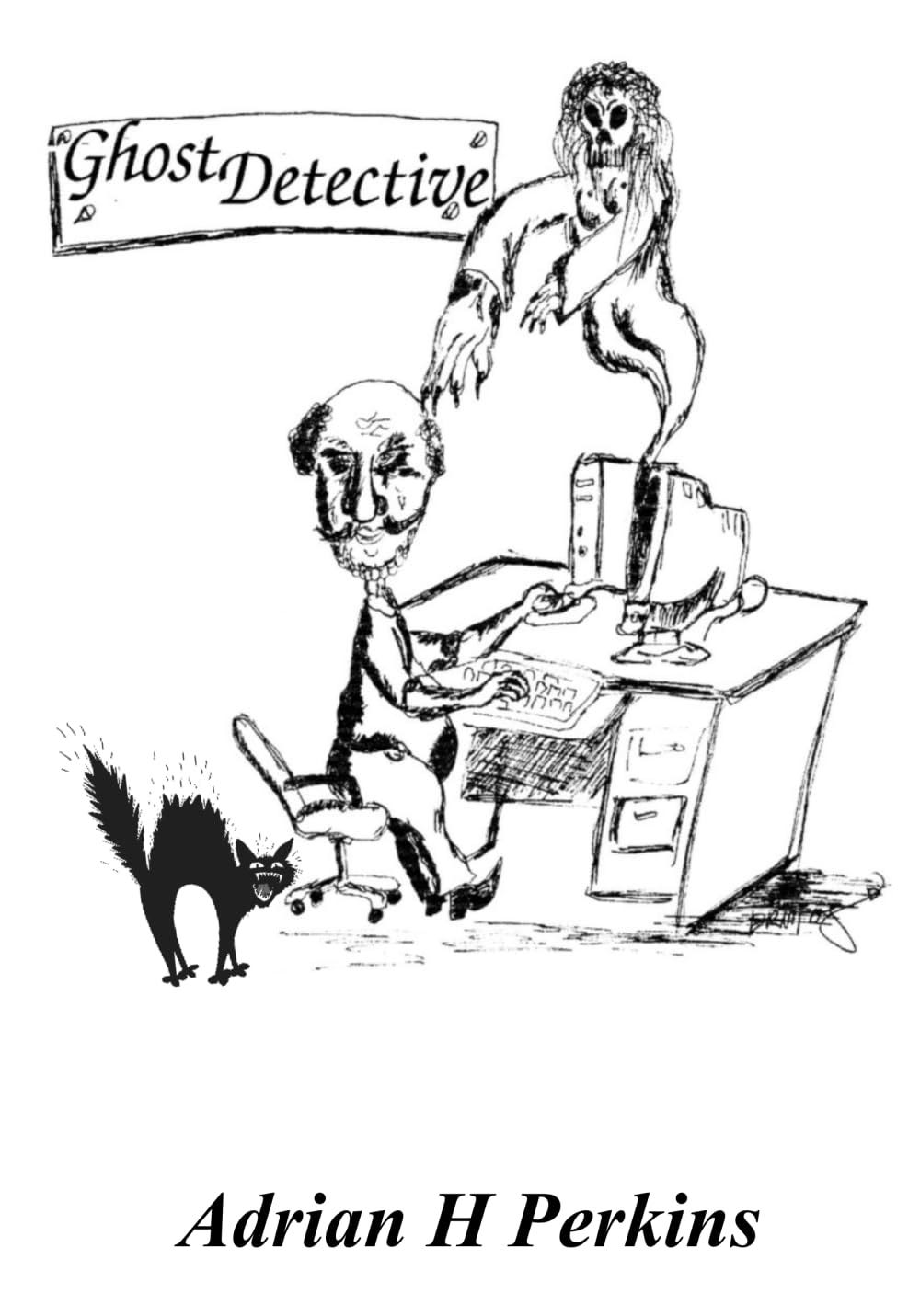
Adrian was surrounded by people telling him their local stories. He was like a doctor opening up his clinic, rolling up his sleeves to determine if it’s viral or a common kitchen poltergeist. He was busy so I left him to it; but he caught my attention and offered me a novel he had written for children suggesting my little boy – who was dawdling nearby – might like it.
‘Oh, thanks that’s really kind … but actually I’m also interested in this,’ I picked up the first volume which had an interesting sketch of a ghost billowing out of a computer on its front cover. As I flicked through it landed on a story entitled ‘The Little Blue Girl’; the word ‘Kingsthorpe’ shined up at me like silver, and I excitedly blurted out that I lived in Kingsthorpe too.
‘You not heard of that story?’
‘No’
He then sucked in his lips like he was about to sell me a cow I couldn’t afford but could do a deal.
‘Ooh it’s an interesting one, you’ll like that. Will stay with you that one.’
He was right.
Later that night I raced through the book, all of the stories were riveting and rang true somehow and gave me the same feeling I had as a child when stories filled you up like cheese on toast. Your belly full, something deep within is sated, and you feel untroubled, cosy. Books have often created such a haven for me.
And then I got to the ‘Little Blue Girl’ and that haven was a little shook. Adrian describes meeting a shy woman, Pauline, who had a story to tell from behind her curtain of hair (well that’s how I imagined it). The chapter describes a quiet self-contained woman who ushers him in to her home; she’s nervous about being the centre of attention, apprehensive about telling her story – one that happened in the early 1970s. She tells him, that as a child she could predict things would happen; tiny things – nothing much more than who would win a raffle at a school fayre or such. But they were small sparks of something, some kind of uncanny ability – yet she also had a sense to keep quiet about it.
Pauline’s sister had a little dormer home in Kingsthorpe (worryingly, I also live in a dormer house in Kingsthorpe). Kingsthorpe is old as ages, right by where the river Nene resides; we’ll all by water, and often watch the plains flood and mist descend. It’s fairly busy with a little shopping centre on a boundary of the town – rich with forestry which seems there one minute and then gone with JCBs and the beginnings of low fresh walls for new houses the next. A sleight of hand I’m sadly getting used to.
Anyway, like all such places, it’s rich with history – a medieval hospital used to stand where my boys go to school, the village now grown into an ‘area’ was once a Danelaw stronghold; the big pub in the centre of it all, The Cock Hotel, was once the last place condemned men were forced to have a last pint on the way to the gallows . It’s not quite Twin Peaks but like any English village or bit of town – it’s a jam of strange stories.
Pauline continued to tell Adrian the account of her sister and her home. Not long after she moved in, her sister kept hearing a cat scratching which was nowhere to be seen – the windows, walls, doors; the scratch scratch seemed to howl let me in let me in. Once the scratching was so loud she dashed into the kitchen thinking the cat had actually got in but, of course, like all of these things – nothing was there. It soon heated up: sitting in the kitchen she had a nervy minute as she watched the door handle move up and down, up and down, this time not a phantom cat who wanted to get in – but a person. Yet no one was ever behind the door. And one night she woke up gasping from a nightmare with a feeling she was being strangled …
Enough was enough, with all this going on, it’s no wonder she felt cornered by madness; so, she confided in Pauline, who she knew had a sense for the strange and other, and she was right, she absolutely understood. Pauline herself came to experience something much more terrifying in the house – or visible at least. She began to babysit her nephew; he would often complain of someone sitting on his feet in the bed and it was upsetting him. One time, Pauline had to stay overnight – she ventured to stay in his room while her nephew slept in his mum’s bed. That night Pauline woke up gasping too – but with a sense there was someone in the room. She looked only to find a little girl at the bottom of her bed bathed in a strange blue light. The little girl was looking at the floor, with a bonnet and dress from another time. Pauline wasn’t so much as frightened but intrigued. She fell back to sleep only to wake again to find she was still there – bright in blue light and not moved from the spot, sadly looking at the floor.
She woke for the third time and she was still there.
In the morning, she told her sister and they agreed: the house had a ghost.
In the months which followed, the family decided to build a garage in the garden – the only thing in its way was a very old wise elm tree. It would have to be moved – and it’s here where the story takes an interesting turn …
Before that, though, let’s talk about elm trees. I’ve decided I both love them – and a little afraid of them. They deserve respect, a nod of the head. There’s not many of them about these days what with the scourge of Dutch Elm Disease in the late 1960s. Younger models emerge from hedgerows unsure and shrub-like – but centuries-old ones, ones who posed for Constable and inspired romantic poets, are harder to find. If you head to Brighton, though, along with a cool sea front and a remarkable Georgian palace, you’ll find a collection of 17,000 mature elms – part of The National Elm Collection.
I love them because they line old paintings; they are billowing and make me think of heaven. They remind me of folklore’s Green Man – and I half expect a face to form among its abundant leaves. Is it any wonder that as the wind flutters its foliage up and down, it looks like Pan dancing on the horizon of England’s pastures.
And women come from them – at least according to Norse lore – the creation of man and woman (Ask and Embla) come from the trees – well, two pieces of driftwood on the shore transformed by the god Odin and his brothers Vili and Vee. Ask – man – translating to ash, and woman Embla meaning elm – although some scholars contest this. That we come from trees – is flattering. That women come from elms – well, that’s just superb.
The elm’s stature made landmarks in yonder year, boundaries of land too; preachers would spread their good word, and judges would mete out their judgement under its hefty boughs. It’s a healer and protector. Churches would plant them in their grounds to protect them from evil. Connected to faeries, an elm is a place for them to make music and merriment – but the elm also negotiates faeries’ power, has a sway with how they use it – making sure they only deploy it for the good.
There are wytch elms, which are the only true native of England – but they are nothing to do with ‘witches’ – in fact churches believed ‘witches’ were wary of them. The word ‘wytch’ comes from the old English word ‘wich’ meaning pliable and flexible.
Why am I afraid of them? Well, maybe their reputation precedes them, perhaps they can subsume us. And they behold a duality. While churches had them in their grounds around graveyards to protect, they’re also a conduit of sorts for death. In Celtic and Nordic mythology, there’s no getting away from it – while seen as a healer, it also taketh away; a symbol of death for many. It certainly stands tall as a protector but its shadow casts ominously. The Celts, in fact, saw them as guardians of the dead believing that elves who kept an eye on the graves lived beneath them.
Coffins are traditionally made from elm too – perhaps partly due to their durability underground – but transporting is what they’re good at; great magnificent pallbearers in a way, their wood a good vessel, flexible enough to cross two worlds however turbulent the sea. In fact, because of their pliable nature they were used for the building of boats; their natural bend making them ideal for movement, journeys, transition – but not so much for the building of houses – here it seems, it could buckle in its stillness. Perhaps it’s a tree of movement then; stillness doesn’t seem to suit its nature, bringing out its wild, darker side. The famous quote ‘Elm hateth man, and waiteth’ because of its frightening tendency to drop heavy boughs on warm still days. Perhaps if it’s not transporting the dead it brings out a nervous tic – a need to bring in the dead, anyway. There’s been many a fatal felling of man from an elm tree.
And while women may come from them, they also can be found dead in them. Since 1944, there’s been a spate of mysterious graffiti appearing on walls in and around Hagley in the West Midlands asking the same question, ‘Who put Luebella down the wytch elm?’ and as the years have gone by, slightly modified to ‘who put Bella in the witch elm?’. The graffiti becoming just as notorious as the very strange discovery it relates to. In 1943, a skull was found by a group of boys on Wytchbury Hill. They came upon a huge ancient wytch elm and decided it might be a good place to find nests (and steal) eggs – what they found instead was a skull in the hollow of the tree. Initially the boys thought it was an animal, but when they looked again with its tufts of hair and set of unique dentistry – well, they realised it could only be human. Fully spooked, the boys vowed not to tell anyone. After all they were trespassing on Lord Cobham’s land. The youngest of the four though, felt terribly guilty and confessed to his parents who immediately alerted the police. In the hollow of the tree, the police found a complete skeleton with its skull and that set of teeth which freaked the boys out (unique enough to give them a hope of finding out who this poor woman was) along with a scrap of taffeta stuffed into her mouth. Her severed hand was found just a short distance away. They deduced that her body must have been still warm, possibly alive, as she was placed in the hollow of the tree – an impossible feat once rigor mortis sets in. It was quickly established that she had suffocated and had been in the tree for eighteen months.
It’s a grisly discovery, the murder never solved, her identity never claimed. Although her identity was desperately sought with a frenzied search of denture records across the country – but with no trace of anyone who might match. Several theories abound, of course, one of which being witchcraft on the account of the scattering of finger bones nearby. Professor Margaret Murray, an anthropologist hypothesized it really was to do with witchcraft citing the ‘hand of glory’ – a disturbing occult ritual used to kill people deemed as witches (which includes the severance of a hand). This really took hold for decades especially with a murder nearby of Charles Walton found dead pinned to the ground with a pitchfork; however, police eventually dismissed a ritualised killing concluding the finger bones nearby were likely the work of animals.
Perhaps the most compelling theory is that she was a German woman named Clara Bauerle. Josef Jakobs, a Czech-born Gestapo agent parachuted into the West Midlands in 1941 and was promptly arrested by the Home Guard. During his interrogation by MI5, he claimed his lover – film actress, musical hall artist and occultist – Clara Bauerle, was also an agent working for the Gestapo and was expected to parachute into the West Midlands in the spring of 1941. He relayed how she used to sing in the music halls in 1930s’ Birmingham and even developed a Birmingham accent, therefore perfect for some West Midlands’ espionage. She was even affectionately known as ‘Clarabella’ to English audiences (hmmm). One of the first appearances of that line of graffiti, hauntingly asks, ‘who put Clarabella down the wythc elm?’. We’ll never know and as Josef Jakobs was the last man to be shot at dawn at The Tower of London, he took all the secrets of Clarabella or Bella down in a pool of blood with him. Interestingly, there was never a trace again of Clara post 1941 – so this theory does have some clout.

Yet to go missing during wartime was very easy, commonplace even ; it was easy to sink without trace especially if you were a sex worker for instance – in 1944 a sex worker actually came forward to claim that a woman she worked with ‘Bella’ went missing on the Hagley road three years previously … this sadly seems plausible and familiar … The question which looms large though is the question about the question, the writing on the wall (sprayed high enough for the police to establish this likely wasn’t kids). How did the graffiti artist have a name and be bold enough to ask it? In this case, the wytch elm, perhaps, only knows …
The elm – murderous maybe, keeper of the underworld – quite possibly, waiting for a woman to subsume or to drop branches on man … such thoughts never crossed the artist, John Constable’s mind, a great capturer of elms. When you look at John Constable’s paintings with its dark smudges and daubs of verdant browns, it’s hard to imagine such barbarous acts; but take a minute to look at his famous painting Study of the Trunk of an Elm Tree. It’s photographic. Its stillness promises something expectant – like a fatal bough might fall, a faerie might playfully hopscotch among its roots, or Charon the ferryman of Hades might emerge … or perhaps a strong woman with plenty to say. Either way, Constable was delighted by them; his good friend C.R. Leslie commenting ‘I have seen him admire a fine tree with an ecstasy of delight like that with which he would catch up a beautiful child in his arms’.
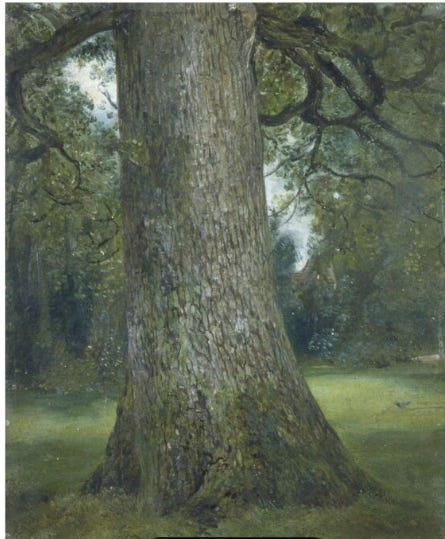
A child in arms and elm trees is relevant to our return to Kingsthorpe and our story of the Little Blue Girl. The elm tree has just been felled to make way for a garage. Depressing as this sounds, the sisters felt an instant visceral sense of relief when the elm was chopped down. All the tension gone – as if a taut rope on a hook in the ground was cut, and they breathed again. Everything felt different – looser, less taut, fraught. The paranormal activity ceased; Pauline never saw the little blue girl again; a spell must have been broken. They really strongly felt it was the elm’s hold over the house. Pauline’s sister knew in her heart, that the elm tree had held the little blue girl. She really felt this – and she couldn’t explain why. Never again did they have any ghost at their door.
Adrian was really intrigued by this thought – that the elm tree could hold a spirit and have a hold on a place. He did some digging around trying to unearth something about the tree – and he found out something pretty sinister. Locals told him that it was always known as … ‘hangman’s tree’. The revelation understandably produced a pearl of sweat on his brow – yet after more digging, there was not much else he could find. I have also got my shovel out but have hit similar hard earth. Nothing. However, Adrian did find out that women persecuted as witches in the sixteenth and seventeenth centuries were hanged from an elm tree and then buried; he states, ‘it was believed the roots of the tree would imprison the evil spirit of the witch for all time.’ He also goes on to make a pretty radical and salient point that with the scourge of Dutch Elm Disease in the early 1970s, how many spirits were released into the John Constable landscape of our everyday lives?
A few weeks ago, I went for a walk with my family in a forest. It’s beautiful known for its giant firs, beech trees and great oaks. Unfortunately no elms, as far as I know. But deep into it, we came across an old beech with a female named pinned to its trunk and garlanded in presents and notes telling the female she was loved and it spoke of all the memories they had. I found it really upsetting, this person was clearly young, and I had no idea why this tree was picked out as a monument of remembrance – whether it was a place of happy memories or something more tragic, I wasn’t sure. Yet because of all the love enshrined around it, it was also beautiful; it radiated life, joy and made me think faeries dancing unseen around all the ribbons and hearts tied and pinned to the tree. It moved me though.
Trees will do that.
Sources:
Northampton Ghost Detective - Adrian H perkins
Links:
17,000 elm trees in Brighton & Hove. Amazing!
Absolutely loved this post. I love trees, so all this history and folklore about elms reached deep into my Writers soul. The poor woman found in the tree was proper chilling. Shivers down the spine horrible, but fascinating too. I can’t get that image out of my head. Superb piece of writing. Looking forward to the newest instalment xx